After 25 years in software development and tech leadership, I’ve learned one universal truth: Almost every industry has at least one process that everyone hates – yet everyone accepts.
In the past months, we at Reeinvent have been helping partners across construction, logistics, and other project-heavy businesses tackle exactly that kind of pain point: The tender and procurement process.
If you’ve ever worked with tenders, you already know the drill. Mountains of documents. Deciphereing of requirements. Weeks of chasing people for “that one reference project from 2016 that proves we built a 50-meter bridge with a project lead who holds certificate X”. In best case, the documents are kept in a file system, in which no one knows the structure of. Some companies still have physical bookshelves of binders they flip through manually. (Yes, in 2025.)
And when you’re handling up to 1000 tender requests a year, the math simply stops adding up.
So, together with a partner in the construction business, we asked ourselves: What if AI could do the heavy lifting? Not to replace the humans who understand the craft, but to finally offload the administrative grind that slows them down.
What followed was a proof of concept that surprised even us.
The Real-World Challenge
Across all partners, we saw the same three goals — and the same three bottlenecks.
1. Send more qualified quotations, without drowning in manual work
Before you can answer a tender, you must:
→ Understand the requirements
→ Prove you meet them
→ Gather reference projects and people with the right experience
Today, this often takes days to weeks. And half the information lives inside someone’s head. If you’re unlucky, that someone is not in your company anymore.
It’s basically like having to build a perfect CV for every job you apply to where you must have written proof for every skill and experience. And of course, 1000 times a year.
2. Actually win the projects you quote
Turns out, many lost tenders aren’t lost because the company wasn’t qualified. They’re lost because the right reference projects weren’t found in time.
When you can’t present the most relevant references, you often fail to qualify – despite being fully capable.
3. Stop spending weeks on tenders you will never qualify for
This one was the real eye-opener: 50% of started procurement assessments end with “we actually don’t qualify,” discovered only after 1–3 weeks of work.
That’s not just inefficient – it’s demoralizing.
If you know on day one that you don’t have the right references, you save incredible amounts of time.
The Idea: AI as Your Tender Co-Pilot
We wanted to build something simple but powerful, an AI-supported workflow that instantly tells you:
- What the tender requires
- Which reference projects match those requirements
- Or if there’s no match at all, so you can walk away early

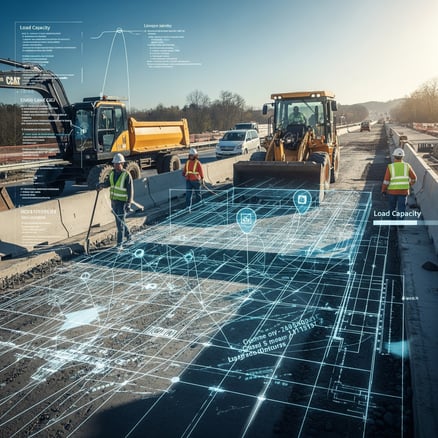
AI Requirement Extraction
Feed in a tender PDF → AI identifies all “technical capacity requirements”.

A Reference Project AI Model
A searchable knowledge model built from the customer’s historical project documentation. We used RAG (Retrieval-Augmented Generation) to let AI “understand” each reference project beyond simple keywords.

The Matchmaking Step
AI maps tender requirements → relevant reference projects.
In seconds. Or, when there’s no match → tells you instantly.
Rapid Prototyping: From Idea to Demo in Weeks
At Reeinvent we have a process we call Rapid Prototyping.The idea is simple: don’t overbuild – prove the concept fast.
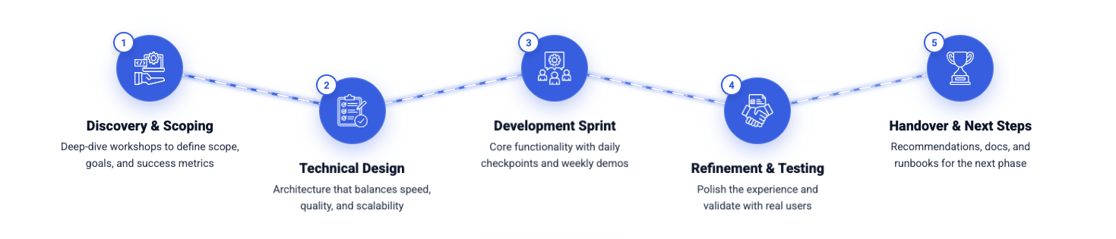
Within a few weeks, we delivered a fully working demo with four key outcomes:
 Functional Prototype
✓ Upload tender
✓ AI extracts requirements
✓ AI searches reference projects
✓ Result: links to matching project references
From chaos → Clarity in one flow
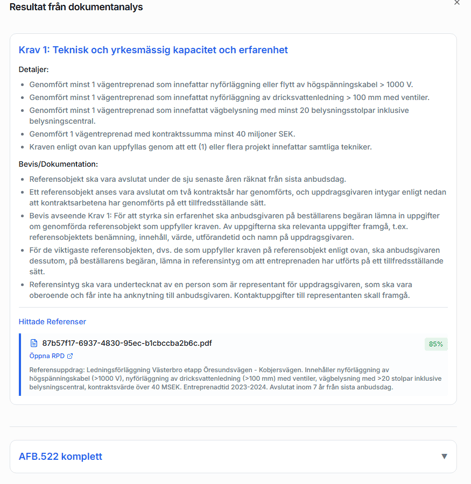
Demo-Ready Interface
We built a clean, intuitive interface where users could test the whole journey themselves: Upload → Analyze → Match → Win
The goal wasn’t perfect UI polish, but something realistic enough to “feel” how a real product would work in production.
Technical Validation
We validated that all major components work in practice:
-
RAG-based reference project portal
-
Automated extraction of technical requirements using AI models
-
Search and matching between tender ↔ Reference projects
-
Support for scaling the architecture with better models and preprocessing
For prototype speed, we used smaller models like GPT5-nano and a limited data set. Search times were sometimes measured in minutes—but that’s normal for early prototypes.
The architecture itself is fully scalable: Larger models → Faster search → Richer matches → Production-ready performance.
User Testing
We ran internal user tests during development. Even with early data, the reactions were consistent:
“Wow. This is exactly what we need.
Imagine what we could do with full data access.“
That’s what a prototype should do – prove value, spark ideas, and create momentum.
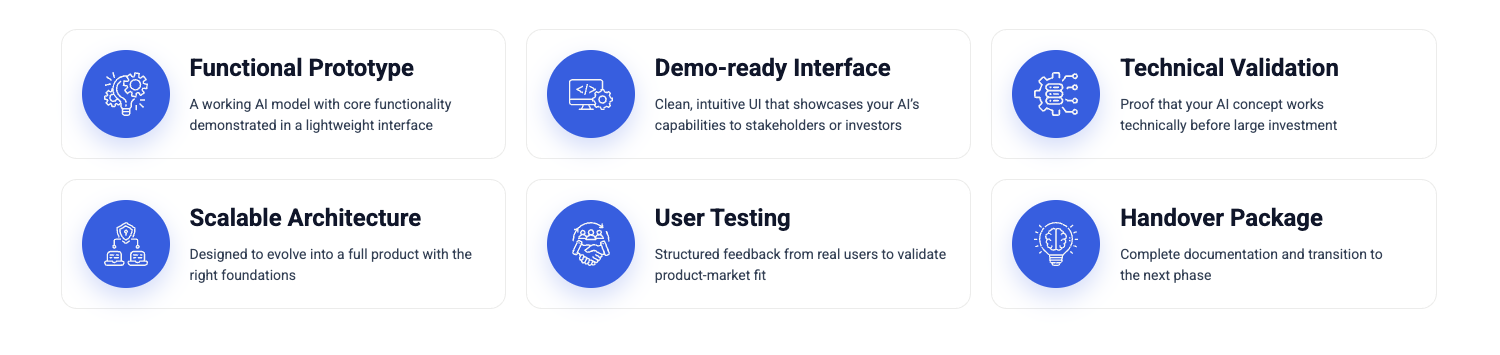
Summary: What We Learned
In just a short time, we proved that:
- AI can reliably extract requirement profiles from tenders
- RAG models can understand and search historical project documentation far better than humans can manually
- Companies can instantly know whether they qualify for a tender
- Relevant reference projects can be found in seconds, not weeks
This lays the foundation for a much broader future, including:
- AI-powered personal CV matching
- Instant procurement go/no-go decisions
- Knowledge discovery across entire organizations
In other words...
“We can finally remove the administrative friction from tender work, so experts can focus on winning the right projects instead of searching through old binders.“
This prototype is just the beginning, but the value is already crystal clear. The best part, besides learning a lot, was having fun along the way by putting technical tools and know how to work to solve a “traditional” challenge.