Vendor Lock-In Risk
Dependency risk grows when tied to a single provider architecture.
Most organisations recognise AI's potential, few have the infrastructure to turn it into measurable productivity gain.
Without a structured foundation, AI remains fragmented, ungoverned and unable to multiply execution capacity.
Dependency risk grows when tied to a single provider architecture.
Governance is unclear, increasing compliance and security risk.
No audit trail across AI interactions or model routing.
AI usage spreads without visibility into data exposure or model behavior.
AI remains experimental, not a productivity multiplier.
No structured framework to measure throughput gains or operational value.
ALMA becomes valuable when it is activated through focused taskforces, structured around workflows, decisions and bottlenecks that matter most.
Manual reconciliation and reporting preparation consume capacity that could drive execution.
Extends ALMA into finance-specific operations, structured workflows for reconciliation, forecasting and reporting that reduce cycle time under governance.
Shorten financial reporting cycles without increasing headcount.
Environmental reporting requires manual data gathering that limits operational throughput.
Extends ALMA into sustainability workflows, integrating with operational data sources to structure and validate emissions reporting under governance controls.
Reduce documentation preparation time while maintaining audit control.
Supplier evaluation and documentation review absorb capacity without scaling output.
Extends ALMA into sourcing processes, structured evaluation workflows and governed knowledge retrieval for supplier assessment and contract review.
Accelerate sourcing decisions and expand capacity without additional headcount.
Predicts short and mid-term liquidity using ERP data, invoices and payment patterns.
Tracks overdue invoices, predicts payment delays and drafts follow-up communication.
Detects unusual transactions, reporting inconsistencies, or fraud indicators.
Aggregates financial data across subsidiaries and generates consolidated reports.
Identifies abnormal spending patterns and contract deviations.
Analyzes equipment data and predicts failures before they occur.
Detects anomalies in production processes and flags quality issues early.
Predicts optimal stock levels based on demand patterns and supply constraints.
Tracks supplier disruptions, geopolitical risks and logistics delays.
Analyzes energy usage patterns and identifies efficiency improvements.
Analyzes pipeline data and flags deals likely to stall.
Recommends pricing adjustments based on demand signals and margin data.
Identifies upsell and cross-sell opportunities within existing customers.
Detects early signals that customers may leave or reduce spending.
Summarizes sales performance across markets, products and regions.
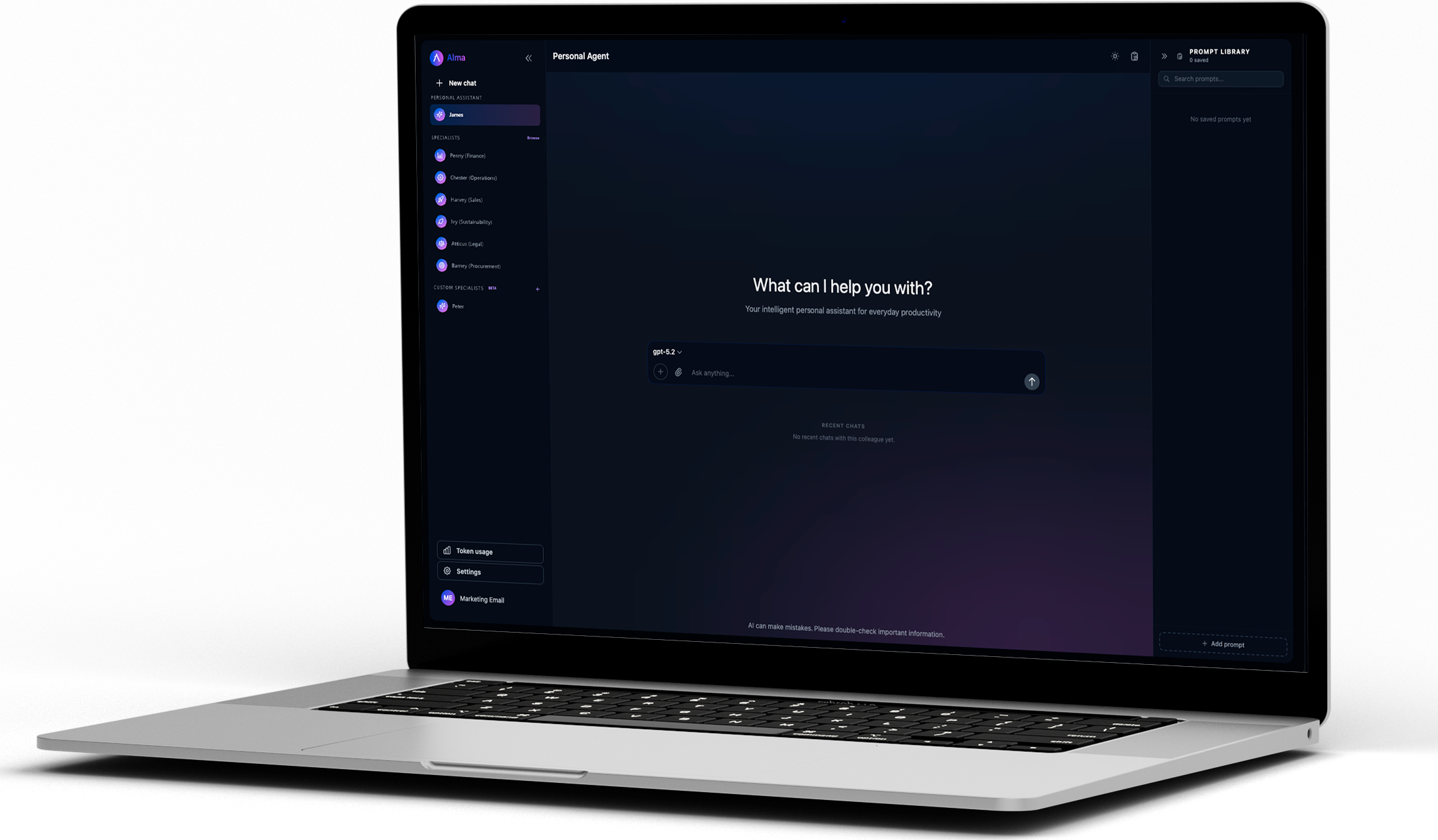
ALMA establishes the correct foundation that lets us multiply productivity across every domain.
Coordinates AI agent Taskforces and workflows activated in ALMA.
Reusable intelligence capabilities used by the agent Taskforces.
The organization's knowledge and operational context.
Connections to the real systems of the company.
Models provide intelligence, ALMA makes it operational.
The continuous development engine behind ALMA.
ALMA follows a clear path from first use case to scaled execution, giving organizations a practical way to launch AI without losing control.
Explore the ALVA case and see how enterprise AI performs when governance, integration and real operational pressure are non-negotiable.
Deploying at scale and structured taskforces is the beginning. AI Capability Program ensures productivity keeps compounding, through continuous governance, platform expansion and portfolio evolution.
Isolated AI initiatives plateau. Without a structured program, productivity gains don't compound and organizations lose operational momentum.
The AI Capability Program creates a structured pathway for ALMA's productivity that compounds as additional Use Case Patterns are deployed, new teams are onboarded.